
Introduction
Every day, more than 7.5 million blog posts go live on the internet. For solopreneurs and small businesses, standing out in that sea of content is a challenge. You need your blog posts to rank well in search engines, appeal to readers, and drive results. But creating SEO-optimized blog posts from scratch is time-consuming and complex.
That’s where AI writing platforms like Mavic come in. With smart content workflows and search-focused automation, Mavic helps you go from blank page to SEO-optimized blog post in just minutes, no need for expensive tools or outsourced writers.
Top 3 Common Queries
- How do I write blog posts that rank on Google?
- Can AI help small businesses with SEO blog writing?
- What’s the fastest way to write high-quality, optimized blog content?
What Is an SEO-Optimized Blog Post?
SEO-optimized blog posts are structured and written to help your content rank higher in search engine results pages (SERPs). These aren’t just well-written pieces, they are strategically crafted to satisfy search algorithms and human readers.
Key Characteristics:
- They target specific keywords related to your niche.
- They follow on-page SEO best practices including proper heading structure, keyword placement, and internal linking.
- They provide valuable, readable content that encourages engagement and action.
Done correctly, an SEO-optimized post increases visibility, drives organic traffic, improves conversions, and supports your long-term marketing goals.
Why SEO-Optimized Blog Posts Matters for Small Businesses
In today’s digital-first economy, having a website alone isn’t enough. Your content must be discoverable, relevant, and strategically written to capture the attention of search engines and human readers alike. Here’s why SEO blog writing is one of the most powerful marketing tools for small businesses.
1. Increased Visibility on Search Engines
Search engines are often the first place potential customers go when looking for products, services, or answers. SEO-optimized blog content helps your business appear in those search results specifically on the first page where over 90% of clicks happen. Well-written blog posts with relevant keywords, metadata, and structured formatting increase your likelihood of showing up for valuable search terms. This means more eyes on your business without spending on paid ads.
2. Attracts Highly Targeted Organic Traffic
Unlike broad advertising campaigns, SEO blog writing allows you to target specific search intents. You can focus on long-tail keywords that align closely with what your ideal customer is searching for whether it’s a solution, how-to guide, or product comparison. This brings visitors who are already interested in your niche and more likely to convert, making every piece of content an organic lead magnet.
3. Cost-Effective and Scalable Marketing
SEO blogging is one of the few marketing tactics that delivers compounding returns over time. While paid ads stop generating traffic once your budget runs out, an SEO-optimized blog post can continue attracting visitors for months or even years after it’s published. With tools like Mavic to automate your content production, SEO becomes a highly efficient and scalable strategy, even for small teams or solopreneurs.
4. Builds Authority and Brand Credibility
Consistently publishing valuable, well-researched blog content helps establish your brand as a thought leader in your industry. When your blog answers key questions, offers in-depth insights, and provides real value, readers and search engines begin to trust your site more. This credibility leads to increased backlinks, longer site visits, and ultimately, better SEO performance.
5. Supports the Entire Go-to-Market Funnel
SEO blog posts aren’t just for awareness. They support multiple stages of your marketing funnel:
- Top-of-funnel: Educate and attract new visitors.
- Middle-of-funnel: Nurture leads by answering objections and positioning solutions.
- Bottom-of-funnel: Drive action through targeted CTAs or product content.
A strategic SEO blogging plan aligns with your product launches, email sequences, and social campaigns – making it a powerful pillar of your overall go-to-market strategy.
Deep Dive into the Problem
Despite the undeniable value of SEO blog content, many small businesses still struggle to implement it effectively – and consistently. These challenges aren’t about motivation. They’re about limited time, knowledge gaps, and lack of affordable resources.
1. Time Pressure and Content Volume
Writing a high-quality, 1500 –1800 word blog post takes time. For small business owners juggling multiple roles, finding hours each week to research, outline, write, and format content is unrealistic. As a result, blog posting becomes inconsistent, sporadic, or abandoned entirely.
2. Navigating the Complexity of SEO
SEO is more than adding keywords – it’s about aligning with search intent, optimizing for readability, ensuring proper technical structure, and balancing on-page factors. Without deep SEO knowledge, it’s easy to make mistakes that prevent your content from ranking, like overstuffing keywords or neglecting metadata and schema.
3. Oversaturated Content Landscape
With millions of blog posts going live daily, it’s increasingly difficult to create content that stands out. Even great content can go unnoticed if it’s not properly optimized for search engines or doesn’t speak to a clear audience need. Many businesses pour energy into content that simply disappears into the noise.
4. Budget and Resource Constraints
Hiring an SEO expert, strategist, or content team is expensive – especially for early-stage businesses or solopreneurs. On the flip side, relying solely on DIY tools often leads to generic content lacking SEO depth or branding consistency. The gap between affordability and quality becomes a major bottleneck.
The Result?
All these challenges lead to:
- Inconsistent publishing schedules
- Underperforming blog traffic
- Wasted time on content that doesn’t convert
And most importantly, they slow your ability to scale your marketing operations.
But with the right platform – one that automates research, content structuring, SEO optimization, and publishing – you can overcome these roadblocks, even without a large team or technical background.
How Mavic Simplifies This Entire Process
Mavic was built to solve exactly these problems for small businesses and solo teams. It combines AI-powered automation with SEO expertise, making high-performing blog content fast, repeatable, and effortless.
AI-Powered Content Creation
Generate 1500+ word blog posts by simply entering a topic and target keyword. Mavic handles the structure, research, and drafting based on proven SEO formats.
SEO Brief Generator
Mavic creates a tailored blog blueprint using your keyword input. It maps out headline ideas, keyword clusters, meta descriptions, and recommended subheadings – all aligned to search intent.
Search-Intent Matching
Mavic analyzes common user questions and SERP data to create posts that satisfy searcher intent, increasing your chances of earning top rankings or featured snippets.
Content Calendar + Publishing
Plan, organize, and schedule your blog posts directly inside Mavic. No more spreadsheets or switching tools.
Multilingual SEO Optimization
Need to reach global customers? Mavic writes SEO-optimized content in 79+ languages – retaining your brand tone and adjusting keywords for local relevance.
Built-In Formatting Best Practices
From title tag optimization to alt text for images, internal linking, and CTA placements – every post generated in Mavic follows best-in-class on-page SEO protocols.
Step-by-Step Walkthrough – Writing an SEO Blog Post in Mavic
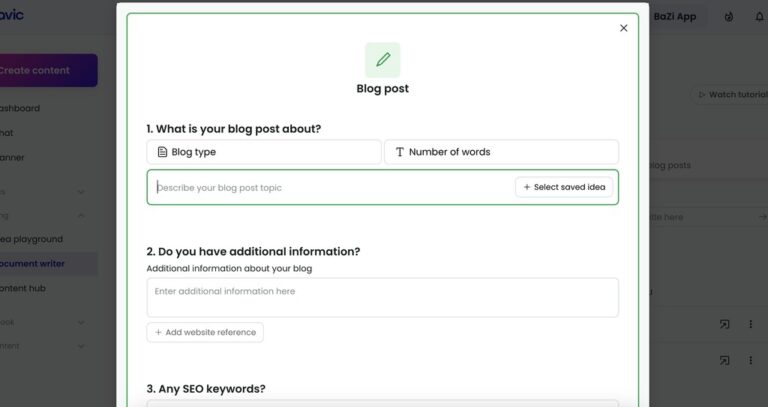
Scenario: Meet Lisa, a Wellness Coach
Lisa is a certified wellness coach who wants to attract more visitors to her website and convert them into clients. Her next content idea: a blog post titled “5 Best Breathing Exercises for Stress Relief.” Rather than juggling multiple tools, she uses Mavic’s all-in-one platform to go from idea to scheduled post—faster and more strategically than ever.
Step 1: Select Topic from Saved Idea
Lisa opens her Mavic dashboard and selects her pre-saved idea from her content board. These saved ideas and collected over time from her brainstorming sessions and past keyword research help her avoid starting from scratch every time.
Step 2: Automatic Web Research
With one click, Mavic runs a real-time web scan of related search queries, trending articles, and user-generated content across forums, blogs, and SERPs. This helps Lisa understand what topics are resonating and what competitors are covering. The research includes keyword intent, common subtopics, and frequently asked questions.
Step 3: AI Document Assistant Builds the Structure

Lisa activates the AI Document Assistant, which builds a structured blog document for her. This includes a suggested H1 title, H2 and H3 subheadings, and even metadata suggestions. It also provides contextual prompts so Lisa knows what to write where or lets Mavic fill in the blanks.
Step 4: Use Outline Generator
For deeper control, Lisa opens Mavic’s Outline Generator. Based on SEO analysis and user queries, it maps out the full structure of her post, ensuring it’s search-intent aligned and includes semantically related keywords.
Step 5: Generate a First Draft
Lisa uses the Rewrite with AI function and clicks “Generate Draft.” Within moments, Mavic delivers a 1600-word post, filled with her selected keywords, optimized headings, and formatted paragraphs. Internal linking suggestions are embedded for blog automation and content optimization.
Step 6: In-Place Editing + Brand Voice Customization
Without switching tools, Lisa edits the text inline using Mavic’s text editor. She updates a few stats, rewrites a sentence, and adjusts tone. She selects “Empathetic + Encouraging” as her brand voice – Mavic adapts the phrasing across the post automatically.
Step 7: Add Visual Elements
Using Mavic’s built-in integrations with royalty-free images and videos, Lisa inserts a calming breathwork animation at the top and a supportive image for each technique. These visuals are all SEO-tagged with alt-text for accessibility and search visibility.
Step 8: Perform an SEO Check
Before publishing, Lisa runs Mavic’s SEO Analysis tool. It checks for keyword density, metadata, readability, image alt text, and mobile responsiveness. Any weak spots are highlighted with suggestions, so Lisa can fix them instantly.
Step 9: Select a Template or Adjust Format
She applies a blog format template, selecting from over 30+ writing styles like how-tos, listicles, tutorials, and interviews. This ensures consistent layout, tone, and formatting for her brand.
Step 10: Schedule and Publish
Lisa finalizes the post and schedules it for next Tuesday at 10 AM. All of this from idea to execution was done inside Mavic, without needing Google Docs, Grammarly, Trello, Canva, or scheduling plugins.
Key Benefits of Using Mavic for SEO Blog Writing
SEO blog writing doesn’t have to be complicated, slow, or fragmented. With Mavic, everything you need from keyword research to content publishing is integrated into one seamless platform. Here’s how it transforms your blogging workflow:
1. End-to-End Blogging in a Single Platform
Mavic is not just a writing tool, it’s your entire content production system. From selecting ideas to SEO checks, text editing to publishing, everything happens in one workspace. No need to switch between apps or platforms.
2. Create SEO Blog Posts in Minutes
Thanks to features like the AI Document Assistant and Rewrite with AI, you can go from topic to first draft in a matter of minutes. No more blank page anxiety. Mavic gives you a head start with fully formed, keyword-optimized content.
3. Built-In SEO Strategy and Analysis
SEO optimization is baked into every step. Mavic auto-analyzes your content for on-page SEO, including title tags, meta descriptions, keyword density, internal linking, mobile formatting, and structured data.
4. Tailored Brand Voice and Tone
With Mavic’s custom brand settings, your content can be personalized to match your tone, whether it’s professional, casual, inspiring, or technical. The voice stays consistent across all posts, even if you have multiple authors.
5. Smart Keyword and Topic Discovery
No need for separate keyword tools. Mavic does automatic web research to find trending queries, user search intent, and keyword opportunities. It recommends phrases that help you rank not just write.
6. Outline Generator for Structured Clarity
Mavic’s outline feature ensures your posts follow a logical flow, cover all necessary subtopics, and reflect how top-ranking content is structured. It’s perfect for writers who want to follow a roadmap before generating or editing.
7. Visual and Multimedia Integration
Direct access to image and video libraries means you can add media content without opening another browser tab. Each image is SEO-optimized with auto-generated alt tags and caption suggestions.
8. 30+ Templates for Different Blog Styles
Whether you’re writing a tutorial, opinion piece, how-to guide, or industry roundup, Mavic includes pre-formatted blog templates and writing styles that make structuring content a breeze.
9. Advanced Editing Without Exporting
Mavic’s comprehensive text editor supports in-place editing, grammar fixes, content rewrites, and formatting tools, so you don’t need Google Docs or a grammar extension to finish your post.
10. Scalable, Repeatable Content Workflows
The workflow Lisa used can be saved and reused. Whether you’re writing one blog post or twenty per month, Mavic helps standardize, scale, and automate your entire SEO blog writing system.
Final Thoughts / Actionable Advice
SEO blog writing is no longer reserved for technical experts or expensive agencies. With the right AI tools, you can publish keyword-optimized, high-quality blog content that ranks and converts – without spending hours researching, outlining, or drafting.
If you’re ready to save time, stay consistent, and turn your blog into a growth engine, Mavic offers everything you need.