Every year, Coca-Cola releases a holiday video around Christmas. The 2025 release was familiar, except their iconic “Holidays Are Coming” ad was reimagined with generative AI [1]. The internet went wild. Comments flooded YouTube criticizing the ad for feeling “uncanny,” “soulless,” and “sloppy.” Many jokingly said they would switch to Pepsi, and industry commentary echoed the exact same reaction.
Coca-Cola’s video was seasonal and on-brand. But it was still in bad taste. The issue was not that the content was unrecognizable. The colors, the logo, and the snow were all on-point. AI can often recreate the visible parts of a brand without delivering the culture behind it. An ad can look like Coca-Cola and still fail to feel like Coca-Cola.
Conversations about AI and marketing miss the point. The significant shift is that brand knowledge can now live inside a system, changing the marketer’s job entirely. If every team has access to the same generative tools, the advantage no longer comes from producing more content. The advantage comes from knowing what to generate, what to reject, what to refine, and what to protect. Simply put, the advantage is taste. The marketer is no longer the sole creator of the output. The marketer is responsible for guiding the system about what the brand means.
Brand Taste Cannot Be Easily Transferred
Imagine a specialty coffee brand with a marketing manager who has been there for eight years. She knows customers respond better to stories about the farmers behind the beans rather than technical roasting details. She remembers that a sustainability campaign performed beautifully, while a discount-heavy push attracted one-time buyers who never returned.
None of this knowledge is fully documented. Some of it exists in old campaign presentations, spreadsheets, Slack conversations, and comments made during meetings. Much of it lives exclusively in her memory.
If she leaves the company, the new marketer inherits the logo, brand colors, and social media accounts. They do not inherit the years of accumulated understanding. They may repeat mistakes or abandon messaging that consistently worked with customers. This kind of knowledge is incredibly valuable and incredibly easy to lose.
This problem extends beyond small brands. A 2022 Sinequa survey of 1,000 IT managers found that 64% felt their organization had experienced knowledge loss due to employee turnover [2].
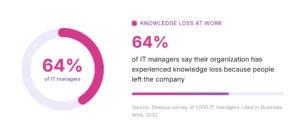
While that finding focused on IT, the problem is painfully familiar to anyone working with brands. When people leave, they take the invisible parts of the brand with them.
The documented elements remain intact. The logo, the color palette, the tagline, and the approved font stay behind. The deeper parts are much harder to preserve. These include the brand’s instincts, its boundaries, its sense of humor, its emotional register, and its memory of past successes and failures.
This explains why brand voice documents often disappoint. They use broad descriptors like “confident but approachable” or “bold but human.” These words fail to help someone make a judgment in the moment.
Should this post be playful or serious? Is this joke clever or off-brand? Is this campaign fresh, or is it different just for the sake of being different?
That is where brand taste lives. Until recently, much of that taste stayed trapped inside people’s heads.
Building a Scalable Brain for Your Brand
The idea of a second brain is simple. It is an external system that organizes and retrieves knowledge so the human brain can focus on higher-order thinking.
For a brand, a good AI system can play that role. It can absorb pieces that usually live separately, such as the visual identity, past campaigns, customer insights, and historical performance data. Over time, it helps a team retrieve and apply that knowledge consistently. Instead of asking every new marketer to rediscover the brand from scratch, the organization can start building a shared memory.
A platform like Mavic fits perfectly into this shift. It serves as a central hub where the brand’s voice, visuals, data, and past learnings begin to work together.
This structural shift makes brand knowledge more portable, searchable, teachable, and scalable. AI can store and recombine brand knowledge, but it cannot decide what the brand should stand for. That requires human judgment.
AI can learn that a brand usually writes in short sentences. It can learn that certain product benefits matter more than others. It does not understand the emotional stakes behind those choices. It cannot explain why a phrase feels chunky, why a visual feels too engineered, or why a campaign is technically on-brand but emotionally empty. Human taste is emotional, irrational, and biased.
The second brain metaphor works only if we remember one crucial detail. A second brain still needs a first brain. The human marketer supplies the meaning. The AI helps organize and express it.
The Marketer’s New Job: Giving the System Taste
In 2025, SAS reported that 85% of marketers used generative AI, with 15% fully integrating it into daily workflows [3].
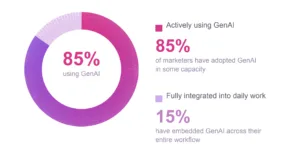
AI is an active part of the everyday marketing system. With everyone using the same generative models, professionals must find a new way to distinguish themselves.
The answer is taste. Taste goes beyond personal preference. In marketing, taste is the ability to recognize whether something carries the brand’s meaning correctly. AI can produce options. The marketer still has to know which option lands best. That requires three new disciplines.
Codifying Brand Taste
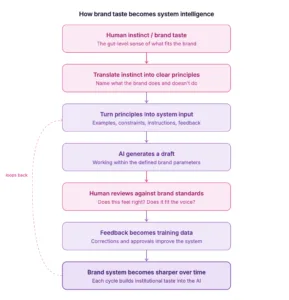
Marketers need to get better at turning instinct into usable input. It is never enough to say a draft feels off or needs to sound more premium. Those comments might make sense to an experienced colleague, but they fail to teach a system anything useful.
A stronger marketer explains why. Premium does not mean longer words. It might mean more restraint, fewer claims, or confidence without urgency. Specificity matters.
The better the input, the better the AI can support the brand. The marketer has to translate tacit knowledge into clear instructions, examples, constraints, and feedback loops. Documentation was once an administrative chore. Today, it is highly strategic. When a system learns from vague inputs, it produces vague outputs.
A sharp instruction changes everything: “Use fewer claims, avoid urgency, write with restraint, and let the product feel confident without sounding like it is trying too hard.”
Key Takeaway #1: Do not view feedback merely as a cleanup task; treat it as valuable training data. A brand’s DNA should constantly evolve. Do not just edit the output. Explain the principle behind the edit so the system avoids the same mistake next time. Every correction makes the brand easier to understand, remember, and reproduce.
Knowing When to Break the Patterns
AI is excellent at recognizing patterns. It studies what the brand has done before and creates more of it. This maintains consistency across markets, channels, and teams. Brands do not grow by repeating themselves forever. They must break patterns.
A new audience might require a new tone. A cultural moment might call for courage. A product launch might need a sharper emotional angle. A safe, consistent output might be technically correct but creatively boring. Human judgment becomes essential here.
A 2024 Harvard Business Review article on AI and brand management highlights Nike’s collaboration with the Parisian art collective Obvious [4]. The team trained a generative AI model on past Air Max designs. They then used human knowledge of fashion trends and Nike’s marketing objectives to refine the output [5]. The final limited-edition shoe balanced novelty with brand recognition and sold out in under 10 days.
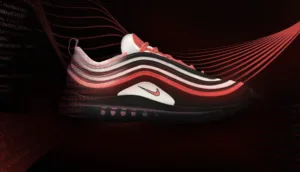
(Source: Obvious, “AI MAX,” 2020)
In this collaboration, AI generated options rather than creating the final answer. Humans decided which option had the right tension. It had to be new enough to feel exciting and familiar enough to feel like Nike.
Key Takeaway #2: Treat AI like a guiding map rather than a steering wheel. It shows the routes the brand has taken before and suggests a natural path forward. You still decide when to stay on course and when a new direction makes sense.
Translating Customer Insight into Action
Codification teaches the system the brand’s internal taste. Translation brings external customer understanding back into the brand for constant improvement.
Marketers remain closest to the human side of the business. They read what customers say, but they also notice hesitation, confusion, excitement, and frustration. They pick up on non-verbal cues and things left unsaid. A good marketer understands the fears, desires, and motivations behind human behavior.
AI can analyze customer data, but it does not live among customers. The marketer must bring that lived understanding back into the system. A customer insight is rarely a simple demographic fact. It is a tension, a fear, or a desire. The marketer turns that human messiness into something actionable.
Knowing that customers want convenience is a basic observation. A nuanced insight goes deeper. Customers want convenience, but they do not want to feel lazy. That gives the brand something emotionally useful. It changes the tone, the examples, the product framing, and the creative direction.
AI can help express that insight in many ways, but the marketer has to find the insight first.
Key Takeaway #3: Every campaign should leave a trail of intelligence behind. Capture what worked and why it worked. This ensures the next output starts from accumulated understanding instead of a blank page.
Good Content Is No Longer Enough
Marketing long valued people who could write well, produce quickly, and keep the content calendar moving. That skillset still matters, but AI makes it less rare.
The market will never suffer from a shortage of posts, captions, emails, or campaign ideas. We will soon drown in perfectly polished options that sound fine, look fine, and disappear almost instantly.
The modern marketer cannot operate simply as an AI prompter. The advantage moves to the people who remain curious, investigative, and willing to ask why. Why did this campaign work? Why did this message fail? Why does this output look on-brand but feel completely wrong?
Customers face an overwhelming amount of noise. They will seek out unique brands they trust, making taste, reliability, and consistency highly valued.
The Coca-Cola example proves the need for strong, proactive marketers. Do not take AI-generated work for granted just because it looks right. Always ask if it feels right. Question whether it improves the brand or merely imitates it. AI can raise the floor of marketing. The ceiling still belongs to human curiosity, judgment, and taste.
Sources:
[1] Coca-Cola, “Holidays Are Coming,” 2025.
[2] Sinequa, survey data cited in Business Wire, 2022.
[3] SAS, “Marketers and AI” report, 2025.
[4] Harvard Business Review, article on AI and brand management, 2024.
[5] Obvious, “AI MAX,” 2020.